
The federal baseline
The equipment every recreational boat must carry is set mainly by federal rules, in Part 175 of Title 33 of the Code of Federal Regulations, and they apply on Baltimore Harbor as anywhere else. Life jackets, which the rules call personal flotation devices or PFDs, come first. Maryland adds its own rules for operators and boats, covered elsewhere on this site. This guide sets out what Part 175 says and turns it into a checklist for a boat in a Baltimore slip.
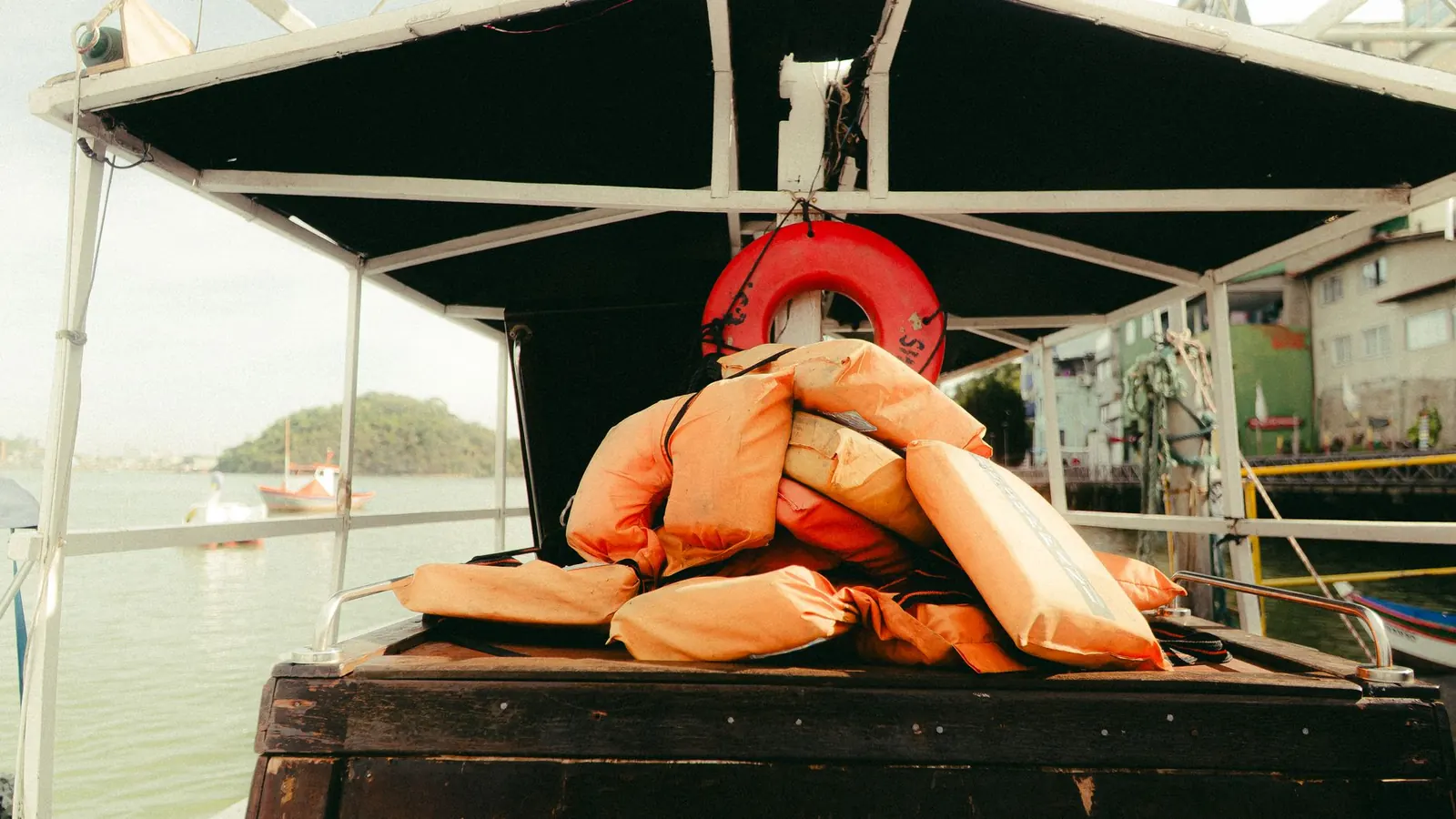
Life jackets: one for everyone
Section 175.15 says no person may use a recreational vessel unless:
- at least one wearable PFD is on board for each person;
- each PFD is used as its approval label requires; and
- each PFD is used as its owner’s manual requires, if the label refers to one.
On a recreational vessel 16 feet or more in length, one throwable PFD must be on board in addition to the wearable ones. Canoes and kayaks 16 feet or longer are exempt from the throwable requirement, and racing shells, rowing sculls, racing canoes and kayaks, and sailboards are exempt from carrying PFDs under this section.
Children must wear them
No person may operate a recreational vessel under way with a child under 13 aboard unless each child is either wearing an appropriate Coast Guard-approved PFD or is below decks or in an enclosed cabin. This is a wearing rule, not a carrying rule: a child’s jacket in the locker does not satisfy it.
Tip: Fit children’s life jackets at the dock, not under way. A jacket that rides up over the chin in the water is the wrong size, and the rules require an appropriate size and fit.
Maryland’s own rule for children
Maryland adds its own requirement in section 8-743 of the Natural Resources Article. A person may not operate, or allow the operation of, a recreational vessel under 21 feet in length with a child under 13 aboard unless the child is wearing a Coast Guard-approved personal flotation device that is properly sized, in good and serviceable condition, and securely and properly attached. For a child under 4, the device must also have features suited to a young child: a strap between the legs that fastens the front and back together, an inflatable headrest or high collar, and a web handle so the child can be lifted from the water.
The Maryland rule does not apply while the vessel is moored or anchored, or to a child who is below deck or in an enclosed cabin. It also covers boats leased, rented or chartered for noncommercial use, but not boats carrying passengers for hire under a Coast Guard-licensed captain.
Stowage and condition
| Rule | What section 175.19 and 175.21 require |
|---|---|
| Wearable PFDs | Readily accessible |
| Throwable PFD | Immediately available |
| Condition | Serviceable |
| Size and fit | Appropriate for the intended wearer, as marked on the approval label |
| Marking | Legibly marked with its approval number |
In plain terms, keep wearable jackets where people can reach them quickly, not buried under cushions in a locked compartment, and keep the throwable where you can grab it at once.
Visual distress signals
Section 175.110 says no person may use a boat 16 feet or more in length, or a boat operating as an uninspected passenger vessel, without visual distress signals of the approved kinds and in the required number. Devices suitable for day use and for night use, or devices suitable for both, must be carried. The rules define where this applies and list the approved signals and alternatives, so check the current text or ask your marina or a boating safety course instructor what your boat needs.
A checklist for a Baltimore slip
- Count the seats and berths, then count the wearable life jackets; keep one for every person you ever carry.
- Keep sizes for any children who come aboard, and put them on before casting off.
- Keep a throwable device on deck if the boat is 16 feet or longer.
- Check labels, straps and buckles at the start of each season and replace anything damaged.
- Check the date and condition of your distress signals.
- Tell guests where everything is before you leave the dock.
Other rules that come with a Maryland boat
Equipment is only part of it. The operator may need a Maryland boating safety certificate, the boat needs its number and title, and a boat with a toilet must handle sewage the way state law requires. See Maryland’s Boating Safety Certificate: Who Needs One, Registering and Titling a Boat in Maryland and Marine Toilets, Y Valves and Pump-Outs in Maryland.
Wearing, not just carrying
The federal rule for adults is about carriage: the jackets must be aboard, accessible and in good condition. Whether adults wear them is mostly a choice. In practice, a life jacket is easiest to put on at the dock, before anyone needs it. Inflatable jackets are comfortable enough to wear all day, but check their approval label and owner’s manual, since the rules require each PFD to be used as its label and manual say.
Guests and borrowed boats
If you lend your boat or carry guests, the same rules apply to them. Show everyone where the jackets and the throwable are before leaving the slip, and make sure children have jackets that fit.
When something goes wrong
Maryland law sets clear duties after a collision or accident, including stopping, helping and reporting. They are explained in Boating Accidents: What Maryland Law Requires of the Operator.